
About:DFN
Doyle-Fuller-Newman model - unlock deep insights into cell behavior with our most comprehensive electrochemical model
Overview
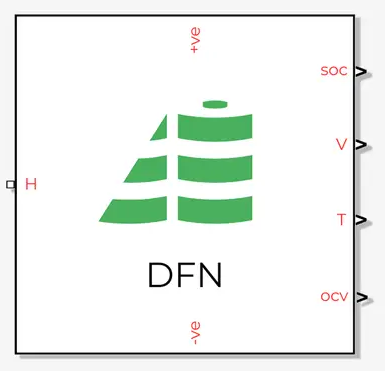
About:DFN is a physics-based model that represents the battery according to a set of physical equations and a corresponding parameter set. It is an extended implementation of the Doyle-Fuller-Newman model (see Literature References) as defined by the Battery Parameter eXchange (BPX) standard (v1.0).
About:DFN predicts:
- Current-voltage relation
- Battery heat dissipation rate
- Individual electrode overpotentials
- Lithiation distribution through electrode and within active material particles
- Electrolyte distribution across electrodes and separator
About:DFN accounts for:
- State-of-charge (SOC)
- Temperature
- Charge-discharge hysteresis
- Rate capability (according to physics-based overvoltage computation)
- Cycling history
Technical Description
About:DFN implements an extended 1D+1D DFN model that builds on the BPX standard (v1.0), in which the macroscopic current-flow direction in each electrode pair is resolved as a linear 1D domain, and the microscopic active material particle properties are described by assuming spherical particles of a Li insertion material in each electrode. All particles of a given material are assumed to have constant size; particle size and shape distributions are not considered.
The macroscopic 1D DFN model predicts the electrolyte current density and the flux of Li\(^+\)-containing electrolyte by solving concentrated solution transport equations for the electrolyte concentration and electrolyte potential. In electron-conducting regions, current density is predicted using Ohm’s law, solving for electric potential. Morphology of porous structures (electrodes and separator) is described using a porous transport theory in terms of homogenised properties (porosity, tortuosity).
Li insertion rate and the corresponding faradaic current density is coupled according to a specified volumetric surface area to a microscopic 1D model, which solves the spherically symmetric Fick’s law diffusion equation to predict inserted Li concentration as a function of particle radius. The open circuit potential of the active material in each electrode can be expressed as either a monotonic function of lithiation extent or as a hysteresis model with separate lithiation and delithation branches, linked by a dynamical decay rate.
To account for blended graphite-Si electrodes, the negative electrode may be expressed as the combination of two capacity reservoirs from different chemical particle types, each with its own set of thermodynamic, kinetic and transport properties. In the case of a two-material negative electrode, hysteresis applies exclusively to the Si-containing material.
Internal heating is computed, including Joule heating (resistive loss) and activation overpotential. Heat of mixing is ignored, to the first approximation. Temperature dependence of various physical quantities is accounted for by the specification of Arrhenius activation energies.
Key features
- Compatible with any thermal model
- Compatible with distributed electronic networks and 3D cell/module/pack models
- Implements an extended 1D+1D Doyle-Fuller-Newman (DFN) model in a manner compatible with the Battery Parameter eXchange (BPX) standard for battery parameter sets
Key applications
- High-fidelity system prototyping for cell integration
- Fast charge protocol design
- Representation of cell performance in 3D thermal models
- Degradation analysis*
* with provision of supplementary degradation data